
Fly fishing in the Great Smoky Mountains National Park is an experience unlike any other. The park boasts approximately 2,900 miles of streams, offering anglers an array of options, from tumbling mountain brooks to wider, more gentle rivers. These waters are home to a variety of fish species, including brook trout, rainbow trout, and brown trout. Brook trout, the only native trout to the area, are particularly prized by anglers for their beautiful colors and willingness to take a dry fly. Rainbow and brown trout were introduced in the early 1900s and have thrived in the park's waters.
Fishing has been a part of the historic use of the Park since its creation. First time anglers to the Smokies should stop by a ranger station or visitor center to ask advice. Sporting goods stores in surrounding communities often house some of the Park's most avid fishermen. Aquatic Life
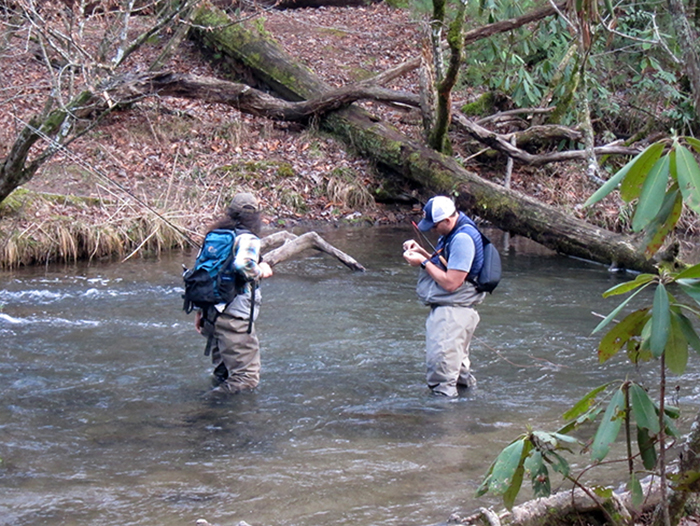 |
| Fishing in Great Smoky Mountains National Park; image @ by Jeaneane Payne |
The best time to fish in the Smokies is typically from spring to fall. Spring brings warmer temperatures and increased insect activity, making for excellent dry fly fishing. Summer can be a bit more challenging due to lower water levels and warmer temperatures, but early morning and late evening fishing can still be productive. Fall is a beautiful time to fish, as the leaves change color and the trout begin to feed more aggressively in preparation for winter.
Some popular fishing destinations within the park include Abrams Creek, known for its large brown trout; Hazel Creek, a remote stream accessible by boat or a strenuous hike; and the Little River, which offers a variety of fishing opportunities for all skill levels. Guided fishing trips are also available for those who want to learn more about the area and improve their fishing skills. Whether you're a seasoned angler or a beginner, fishing in Great Smoky Mountains National Park is an unforgettable experience that will leave you with a deep appreciation for the beauty and tranquility of the natural world.
Regulations:
Fishing is permitted year-round in the park, from 30 minutes before official sunrise to 30 minutes after official sunset. The park allows fishing in all streams EXCEPT the following streams and their tributaries upstream from the points described:
North Carolina: Bear Creek at its junction with Forney Creek.
Tennessee: Sams Creek at the confluence with Thunderhead Prong; Indian Flats Prong at the Middle Prong Trial crossing.
Fishing is permitted year-round in the park, from 30 minutes before official sunrise to 30 minutes after official sunset. The park allows fishing in all streams EXCEPT the following streams and their tributaries upstream from the points described:
North Carolina: Bear Creek at its junction with Forney Creek.
Tennessee: Sams Creek at the confluence with Thunderhead Prong; Indian Flats Prong at the Middle Prong Trail crossing
TROUT TOURNAMENTS:
Cherokee Trout Tournaments
Cherokee's Dog Days Trout Tournament
Smoky Mountain Trout Tournament
Anglers are now able to fish for brook trout in park streams.
Smokies Angling Adventures
www.smokiesangling.com
Outfitters:
• GSM Outfitters LLC, 3275 Wears Valley Road, Sevierville, TN 37862
• Little River Outfitters, 106 Town Square Drive, Townsend, TN 37882
• Nanthala Outdoor Center, 1138 Parkway, Gatlinburg TN 37738
• Outpost Mountain Outfitters, 4768 U.S. 74 Whittier, NC 28789
• Rivers Edge Outfitters - 1235 Seven Clans Lane, Whittier, NC 28789
• Rocky Top Outfitters
License:
Tennessee - Purchase license online
North Carolina - Purchase license online
Persons possessing a valid Tennessee or North Carolina state fishing license may fish all open Park waters. Licenses must be displayed on demand by authorized personnel. State trout stamps are not required.
Tennessee License Requirements
Residents and non-residents age 13 and older need a license. The exception is residents who were 65 prior to March 1, 1990. These persons require only proof of age and Tennessee residence.
North Carolina License Requirements
Residents and nonresidents age 16 and older need a license. Residents age 70 and older may obtain a special license from the state.
Persons under 16 in North Carolina and under 13 in Tennessee are entitled to the adult daily bag and possession limits and are subject to all other regulations.
The Park does not sell state fishing licenses. They may be purchased in nearby towns.
Size Limits
Rainbow and Brown Trout: 7" minimum
Smallmouth Bass: 7" minimum
Rockbass (redeye): No size limit
All trout or smallmouth bass caught less than the legal length shall be immediately returned to the water from which it was taken. Any brook trout caught must be immediately returned unharmed to the water.
Lures, Bait and Equipment
1. Fishing is permitted only by the use of one hand-held rod.
2. Only artificial flies or lures with a single hook may be used.
3. The use or possession of any form of fish bait or liquid scent other than artificial flies or lures on or along any Park stream while in possession of fishing tackle is prohibited.
4. Prohibited baits include, but are not limited to, minnows (live or preserved), worms, corn, cheese, bread, salmon eggs, pork rinds, liquid scents and natural baits found along stream.
5. The use or possession of double, treble or gang hooks is prohibited while on a stream.
6. Fishing tackle and equipment including creels and fish in possession are subject to inspection by authorized personnel.
Releasing Fish
1. Play a fish as rapidly as possible, do not play to total exhaustion.
2. Keep fish in water as much as possible when handling.
3. Handle fish with a wet hand, even when using a mesh landing net.
4. Remove hook gently; do not squeeze fish or put fingers in gills. Use long-nosed pliers to back the hook out gently. The use of barbless hooks is encouraged.
5. If deeply hooked, cut the line, do not pull the hook out. Most fish survive with hooks left in them.
6. Gently hold fish upright facing upstream and move slowly back and forth in the water.
7. Release fish in quiet water.
Time
Fishing is allowed from a half hour before official sunrise to a half hour after official sunset.
Daily Possession Limits
Five (5) rainbow or brown trout, small mouth bass, or a combination of these, each day or in possession, regardless of whether they are fresh, stored in an ice chest, or otherwise preserved. The combined total must not exceed five fish.
Twenty (20) rockbass may be kept in addition to the above limit.
A person must stop fishing immediately after obtaining the limit.
Please report violators to nearest ranger or to (865) 436-1294.
Poaching robs fishermen of fish and all citizens of a valuable natural heritage. You can help by reporting incidents when you see them. Remember, you will remain anonymous. Record vehicle description and license plate number if possible.
Disturbing and moving rocks to form channels and rock dams is illegal in the park! Moving rocks is harmful to both fish and aquatic insects that live in the streams. Many fish species that live in the park spawn between April and August. Some of these fish build their nests in small cavities under rocks and even guard the nest. When people move the rock, the nest is destroyed and the eggs and/or young fish die.
Aquatic insects need rocks for cover as well. Some aquatic insects can drift off or move when disturbed, but many species attach themselves to the rock and cannot move. When a rock is moved, aquatic insects fall, are crushed by the movement, or dry out and die when the rock is placed out of water.
One of the fundamental policies of the National Park Service is to preserve natural resources in an unaltered state. Consequently, it is against the law to move rocks in the stream. Please abide by these rules so that future generations may enjoy the park as well.
| Trip Ideas Great Smoky Mountains Facts Institute at Tremont Transportation & Airports Local News Photo Tours • Fall Photo Tour • Roaring Fork Motor Nature Trail • Smoky Mountain Fall Foliage • Fall Foliage at Kuhowi • Fall Colors in nearby towns • Fall in Wears Valley • Best Fall Hikes |
WHAT TO DO Attractions Biking Fishing Hiking Outdoor Adventure Scenic Drives Shopping Heritage, History, & Culture Nature Activities 4 SEASONS Winter Spring Summer Fall WEDDINGS Wedding Services Honeymoon Cabins |
WHERE TO EAT Restaurants Farmers' Markets Recipe Cards Surrounding Towns: • Cherokee • Gatlinburg • Pigeon Forge • Townsend • Wears Valley CONTACT |
||
